
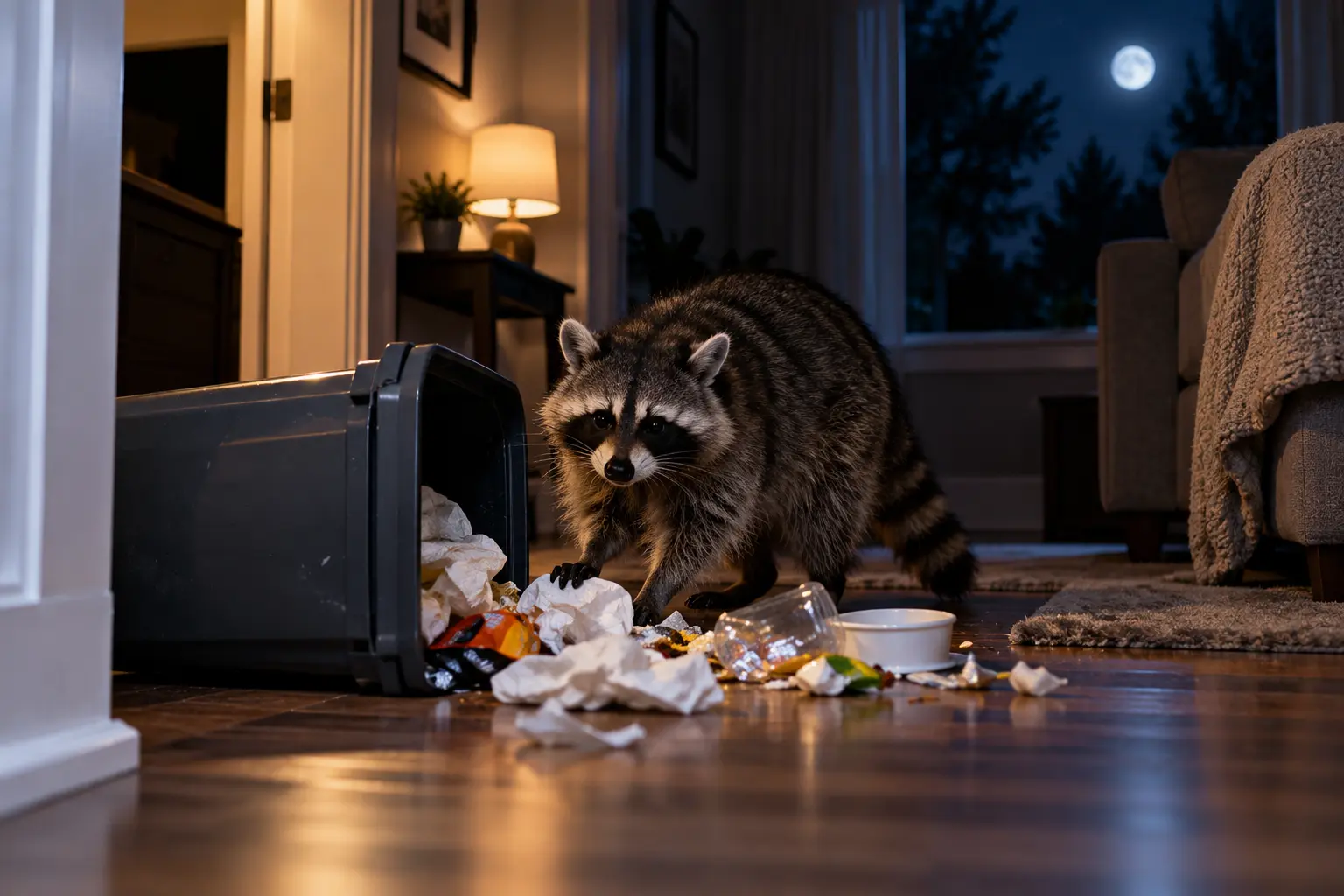
Signs of a Raccoon in the House at Night and How to Deal With Them
Most people go looking for the signs of a raccoon in the house at night because something woke them up and they are not sure what it was. That is the right instinct. By the time a raccoon is audible from a bedroom, it has usually been in the roof space for a while, and what it does up there gets more expensive the longer it goes on.
This covers how to tell a raccoon from the alternatives, what to check in daylight, and what to do first. It also covers one thing you are not permitted to do in Texas, which a lot of advice online gets wrong.
How to Tell if a Raccoon Is in Your House
Weight and timing tell you most of it, and you can work it out from bed without getting up.
Raccoon, Rat or Squirrel? What the Noise Tells You
A rat is light and fast. What you hear is scurrying and scratching, often inside a wall cavity rather than overhead, and it comes in short bursts that stop when you move.
A squirrel is light too, but the timing gives it away. Squirrels work in daylight and go quiet after dusk. If the noise starts at nine in the evening and runs past midnight, it is not a squirrel.
A raccoon is heavy enough that you hear individual footfalls rather than a rustle. It is loudest between dusk and the small hours. It drags and thumps as it moves nesting material about, and it does not stop just because you banged on the ceiling. If it sounds like a person crawling around above the ceiling, it is almost certainly a raccoon. If it sounds like water running inside the walls, it is rodents.
The Signs of a Raccoon in the House at Night
Seven things to look and listen for. The first two happen after dark. The rest you check in daylight.
- Heavy footsteps overhead. Slow, deliberate, and loud enough to follow across the ceiling. Rodents cannot make this sound.
- Chittering, growling, or a chirping that sounds almost like birds. That last one is usually kits, and it means there is more than one animal up there.
- Damage at the roofline. Lifted shingles, a torn soffit, a bent or missing vent cover, and fascia pulled away at a corner. Raccoons do not squeeze through gaps; they make them.
- Tracks. Five long toes with visible claw marks, more like a small handprint than a paw print. Look in soft ground by the downspouts and on dusty flat roof sections.
- Droppings in a consistent spot. Raccoons return to the same place, which is called a latrine. Tube shaped, dark, and often with visible seeds or insect fragments.
- Bins turned over, and pet food gone from the porch. On its own, this means a raccoon on the property. Combined with any sign above, it means one living in the structure.
- A sighting in daylight. Raccoons are mostly nocturnal, so a daytime appearance near the house is worth noting. It is not proof of illness, despite what you will read. A nursing mother will forage at odd hours because she has to.
Signs of a Raccoon Infestation in a House, and When It Is More Than One
The question that changes the whole job is whether you have one animal or a female with young. From roughly February through to early summer, a raccoon in a roof space is very often a mother who has chosen it as a den, which is the single most common reason a raccoon is in a house at all.
Signs it is a litter rather than a lone animal: the chirping noise described above, a sound coming from one fixed location rather than moving around, activity at odd hours including daylight, and a marked increase in noise over two or three weeks as the kits grow.
This matters practically. Seal the entry point with kits inside, and the mother will tear a new hole to get back to them, usually somewhere worse. If she cannot, the kits die in the cavity, and then you have a different problem in your ceiling. Anyone who offers to simply board up the gap without checking has not done this before.
What to Do Tonight and What to Leave Alone
There is a short list of things worth doing straight away and a shorter list of things that make it worse.
Worth doing: Bring pet food indoors, secure the bins, and turn off anything that is drawing them in. Take a flashlight outside at dusk and watch the roofline for ten minutes, because seeing where the animal comes out tells you more than any inspection from inside. Photograph the damage while you are there.
Leave alone: Do not go into the attic to look. Not because of a dramatic confrontation, which is unlikely, but because of what is on the floor up there. Do not seal any opening until you know whether anything is inside. And do not buy a trap, for the reason in the next section.
Why You Cannot Simply Trap and Relocate in Texas
This is where a lot of online advice goes wrong, including advice written for other states. Texas Parks and Wildlife is explicit that raccoons cannot be transported because of rabies quarantine restrictions. So the familiar plan of catching one in a live trap and letting it go somewhere leafy a few miles away is not an option here, however humane the intention.
What does work is exclusion. You establish where the animal is getting in, make sure nothing is left inside, fit a one way door so it can leave and not return, and then close the opening properly once it has gone. The animal ends up outside where it was always going to be, and the building stops being available. It is also the only approach that actually finishes the problem, because an open entry point simply gets used by the next one.
If you are weighing up handling it yourself, this is the part we would point to. The rules on what you may do with a trapped raccoon are narrower than most people expect, and getting it wrong is a worse outcome than paying somebody.
The Health Risk Worth Knowing About
Not to alarm anybody, because human cases are genuinely rare. But it is specific enough to be worth stating properly rather than with a vague warning about disease.
Raccoons can carry Baylisascaris procyonis, usually called raccoon roundworm. The eggs are shed in droppings and, according to the CDC, need two to four weeks in the environment before they become infectious. Human infection is uncommon but can be serious, and most cases are in young children, who are likelier to get contaminated material into their mouths.
The practical takeaway is simple. A raccoon latrine in an attic or a yard should be cleared promptly rather than left, because clearing it before that two- to four-week window closes is what removes the risk. It also means attic clearance is not a job to do casually in a dust mask on a Saturday. Rabies is the other consideration, and it is the reason for the transport restriction above.
When to Call a Raccoon in the House Removal Service
Call somebody if you have heard heavy movement overhead for more than a night or two, if you can hear more than one animal, if there is any chirping, or if you have found droppings inside the structure. Those four between them cover almost every case that is not going to resolve itself.
What a proper job involves: a full inspection to find every opening rather than the obvious one, a check for young before anything is sealed, one way exclusion, repair of the entry points in materials the animal cannot simply reopen, and clearance of contaminated insulation where it is needed. A quote that covers only removing the animal is not a quote for solving the problem.
Conquest Pest Services has run professional wildlife removal across Fort Bend County and Greater Houston for over twenty years, and we will tell you honestly whether what you are hearing needs us or not. Tell us what you have heard and when, and request a free estimate.
Raccoon in the Attic FAQs
Will a raccoon leave the attic on its own?
Often, eventually. A female will usually move her kits out once they are mobile, which can be anything from six to ten weeks after they are born, and a lone animal may move on when the weather turns. The problem is that waiting solves nothing. The opening it used is still there, the insulation is still flattened and soiled, and the next raccoon that comes past finds a den that is already made. Almost every attic we exclude has signs of more than one occupancy over the years.
Is it safe to sleep in the house with a raccoon in the attic?
For one or two nights, yes. A raccoon in a roof space has no interest in coming down into the living area and the ceiling between you is a real barrier. What is not safe is going up there to investigate, because of the droppings, and leaving it for weeks, because of what accumulates. If anybody in the house has gone into the attic without protection, or if a child has been near droppings, that is worth a call to your doctor rather than a wait and see.
What time of night are raccoons most active?
Most people hear them in the first couple of hours after dark, when the animal leaves to forage, and again in the early hours when it returns. That pattern is itself useful. If the noise is loudest at the same two points each night and quiet in between, you are listening to one animal coming and going. If there is movement throughout the night from a fixed spot, there is something staying up there, which usually means young.
Get the Attic Looked At
A raccoon in a roof space is not an emergency on the first night, but it does not improve on its own, and the damage is cumulative. Insulation gets flattened and soiled, vents get widened, and in a bad case, wiring gets chewed.
If you have heard something heavy moving overhead after dark, send us the time of day you hear it and what it sounds like. That alone usually tells us what we are dealing with. We cover nineteen cities across the area, and the inspection is free.

